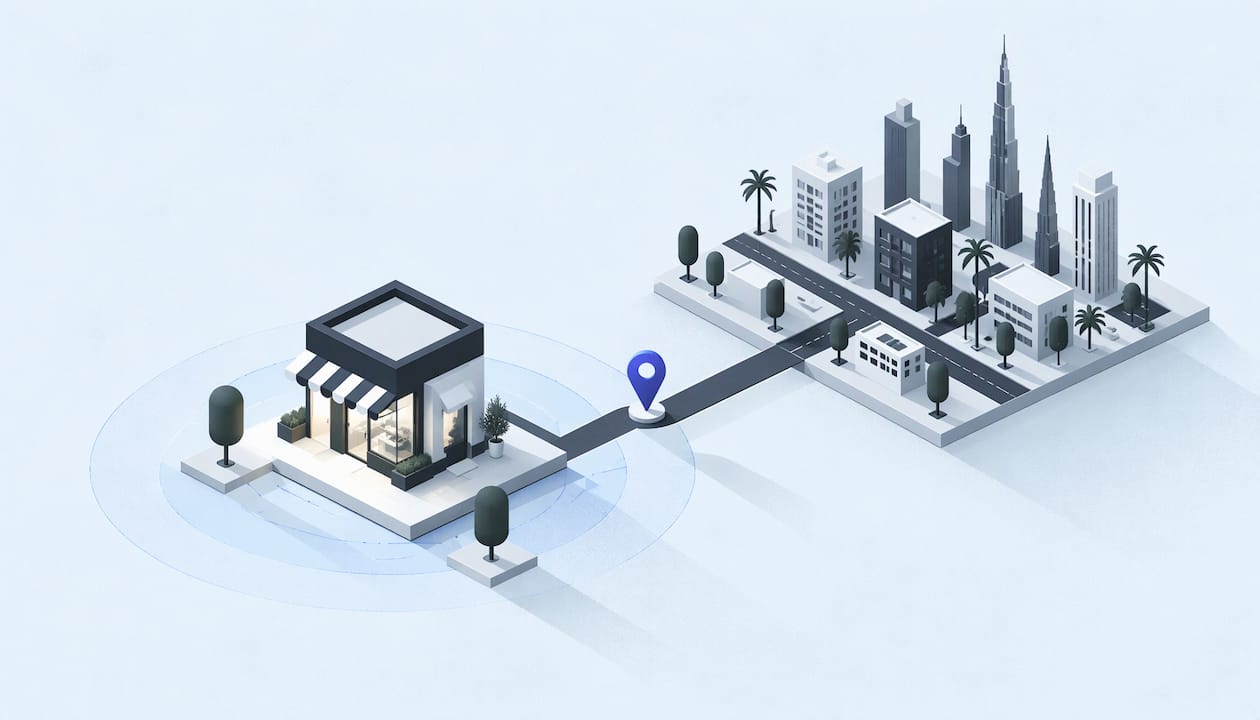
Local SEO is how a small business shows up when people nearby search for what it sells. In the UAE that means getting your Google Business Profile, your website, your reviews and your listings to say the same clear thing about what you do and where you do it. Do that consistently and you appear in the map results and local listings for searches in your emirate, city or neighbourhood. This guide gives the order of work, what to fix on each part, and how to tell whether it is working.
TL;DR
- Google decides local results on three things: relevance, distance and prominence. You control relevance and prominence directly.
- Start with a complete, accurate Google Business Profile, then fix your website's local signals, then build reviews and listings.
- Answer every review, positive or negative, ideally within 24 to 48 hours.
- Measure three layers every month: profile actions, local rank across your service area, and website conversions.
- Our Local SEO plan is AED 1,500 per month, fixed and published, and you can see a free demo check before paying.
Table of Contents
- What local SEO actually is
- Step 1: Set up your Google Business Profile properly
- Step 2: Find the local keywords your customers use
- Step 3: Make your website say where you are and what you do
- Step 4: Build citations and local links that match
- Step 5: Earn and manage customer reviews
- Step 6: Measure whether it is working
- A realistic 90-day plan
- Our perspective
- Getting help with local SEO in the UAE
- FAQ
- Sources
What local SEO actually is
When someone in Dubai Marina types "dentist near me" or someone in Sharjah searches for an AC repair company, Google shows a map pack and a list of local businesses. Local SEO is the work that earns a place there.
Google's own description of local ranking uses three factors, as summarised by SEOPressor from Google's support page:
- Relevance: how well your Business Profile matches what the person searched for.
- Distance: how far you are from the searcher, or from the location they named.
- Prominence: how well known you are, based on reviews, links, articles and directories across the web.
You cannot change distance. A café in Al Quoz will not outrank one on the same street for a searcher standing outside it. But relevance and prominence are work you can do, and a small business with a tidy profile and steady reviews often beats a larger name that has neglected both.
This is also why local SEO suits small businesses. You do not need to beat the whole internet. You need to be the most relevant and best-trusted option within a limited area.
Step 1: Set up your Google Business Profile properly
Your Google Business Profile is the single most important local asset. For many searches it is the first thing a customer sees, before your website.
Claim and verify it
Create or claim the profile using the Google account your business controls, not a freelancer's personal account. Then complete verification. An unverified profile is limited in what it can do, so treat this as the first job rather than the last.
Choose the right categories
Pick one primary category that describes your main service in the words Google offers, then add secondary categories for genuine secondary services. A common mistake is choosing a broad category such as "Consultant" when a precise one like "Accountant" or "Interior designer" exists. The primary category carries the most weight for relevance, so it should match what you most want to be found for.
Handle your address or service area honestly

If customers visit you, show your address exactly as it appears on your trade licence and signage. If you travel to customers, such as a cleaner, electrician or mobile groomer, set the areas you serve instead of pretending to have a shopfront. Name the neighbourhoods and emirates you genuinely cover, not the whole country. Check the current rules on Google's Business Profile guidelines before you set this up, because Google changes what it allows and suspends profiles that break the rules.
Fill in everything
- Business name exactly as customers know it, with no keywords stuffed in.
- Opening hours, including Friday and holiday hours, and Ramadan hours when they change.
- A phone number that is answered, ideally a local number.
- Your website link, pointing to the page most relevant to the profile.
- Services or products with short descriptions in plain language.
- Real photos of your premises, team and work. Stock images add nothing.
- English and Arabic details where your customers use both.
After the basics, use posts and updates sparingly but regularly. A profile that shows recent activity tells visitors you are open and responsive.
Step 2: Find the local keywords your customers use
Local keyword research is simpler than general SEO research because the pattern is predictable: a service plus a place. "Physiotherapy Jumeirah", "villa painting Arabian Ranches", "accountant Business Bay".
Build your list in four layers:
- Core services: what you sell, in the words customers use rather than your internal names.
- Places: the emirate, the district and the neighbourhoods you serve. Dubai customers often search by community name, so include them where you genuinely operate.
- Intent modifiers: "near me", "open now", "24 hour", "cheap", "best", "same day".
- Language: whether your customers search in English, Arabic or a mix. If both, plan Arabic content rather than assuming a translation is enough.
Then look at what Google shows when you type your main phrases yourself. The autocomplete suggestions and the "people also ask" boxes are free evidence of real wording. Note which businesses sit in the map pack and what their profiles emphasise.
Keep the list short at first. Ten to fifteen phrases mapped to specific pages are more useful than a spreadsheet of three hundred.
Step 3: Make your website say where you are and what you do
Your profile gets you into the map pack. Your website is what convinces Google that the profile is relevant, and what turns a click into an enquiry.
One page per service, and per location where it is real
A single "Services" page that lists everything gives Google and visitors little to work with. Give each main service its own page, with a clear heading, a description of what is included, who it is for, and the areas you serve. If you genuinely operate in more than one emirate or area, add a page for each with real content, such as local examples and specifics. Near-identical pages with only the place name swapped add little value and are best avoided.
Put your name, address and phone number in plain text
Show your business name, address and phone number in the footer or a contact page as text, not as an image. Make them match your Business Profile exactly, character for character where possible.
Page titles, headings and descriptions
Write the title of each service page around the service and the place. Use one H1 that says the same. Keep descriptions human: they are what a searcher reads before deciding to click.
Speed and mobile use
Most local searches happen on a phone, often by someone who wants an answer quickly. A slow or awkward mobile site loses the enquiry even when you rank well. Our site performance and technical fixes service, from $400, covers exactly this kind of clean-up.
Make it easy to act
A click-to-call button, a WhatsApp link, a short enquiry form and a map are the actions local customers want. Put them where they can be seen without scrolling. If your site is a template that cannot be changed in these ways, a custom build solves it: our web design from AED 1,800 starts with a Starter Website at AED 1,800 one-off.
Step 4: Build citations and local links that match
Prominence comes partly from being mentioned consistently across the web. A citation is a mention of your business name, address and phone number on another site, such as a directory, a chamber listing or an industry association page.
Consistency matters more than volume. Pick the exact format of your name, address and phone number, write it down, and use it everywhere. Differences such as "Street" against "St.", an old phone number or a former office create confusion about which listing is the real business. BrightLocal's guidance on managing listings covers the audit routine for finding and fixing these.
A sensible order of work:
- Audit what already exists. Search your business name and your phone number and list every page that shows them.
- Correct or remove outdated or duplicate listings.
- Add listings on the main general directories used in the UAE and on directories specific to your industry.
- Ask for mentions where a real relationship exists: suppliers, partners, event organisers, community groups, local press and your own free-zone or business network.
Local links earn their keep when they come from a real connection. A sponsorship of a community event, a supplier page listing you as a stockist, or a feature in a neighbourhood publication say more about you than a dozen anonymous directory entries.
Step 5: Earn and manage customer reviews
Reviews feed prominence and also decide whether a searcher picks you once they see you. Treat them as an ongoing routine, not a campaign.
Ask at the right moment. The best time is just after a job is done or a purchase is collected, when the customer is pleased. Send the direct review link by WhatsApp or SMS, and make the request personal and short. Never offer payment for reviews or write them yourself: it breaks platform rules and customers notice.
Reply to all of them. According to BrightLocal's Local Consumer Review Survey, 89% of consumers expect owners to respond to all types of reviews, and the practice it recommends is replying to every review, positive or negative, ideally within 24 to 48 hours.
A workable approach:
- Positive review: thank them by name, mention the specific service, and invite them back.
- Negative review: respond calmly, apologise for the experience without arguing, state what you will do, and offer a direct phone or email contact to resolve it. Other readers judge you by the reply as much as by the complaint.
- Weekly habit: put a fixed time in the diary to check and reply, so no review waits for weeks.
Specific reviews also help relevance. A customer who writes about the service and the area they live in gives you wording no description can match. You can encourage this simply by asking, "Would you mind mentioning what we did for you?"
Step 6: Measure whether it is working
Local SEO takes weeks to show movement, so you need a measurement habit that tells you early whether you are going in the right direction. DreamHost's local SEO reporting guide suggests tracking three layers, which is the approach we use too:
| Layer | What to watch | Why it matters |
|---|---|---|
| Google Business Profile | Views, calls, direction requests, website clicks | Shows whether people see you and act |
| Local rank tracking | Your position across a grid covering your service area | Shows where you are strong and where you are invisible |
| Website analytics (GA4) | Conversions from visitors the profile sends to the site | Shows whether visibility turns into enquiries |
Compare each month against the trailing three-month average and against the same month last year, as the same guide recommends. Month-on-month alone misleads in the UAE, where summer travel, Ramadan and year-end shopping all shift demand.
The third layer is the one many small businesses skip. If calls and form submissions are not tracked as conversions, you cannot link effort to revenue. Our GA4 and tracking setup, with a Tracking Health Check at $250, is built for this.
A realistic 90-day plan
Days 1 to 14: foundations. Claim and verify the profile, choose categories, complete every field, add real photos. Audit existing listings and write down your standard name, address and phone format.
Days 15 to 45: website. Create or rewrite one page for each main service, with location detail, matching contact details and a clear call to action. Fix speed and mobile issues. Set up call and form tracking.
Days 46 to 90: prominence. Correct citations, add the relevant directories, begin a steady review request routine and answer every review. Start monthly reporting so you have a baseline.
After 90 days you will have a working picture: which searches bring views, which pages bring enquiries, and where your service area has gaps.
Our perspective
Most small businesses we speak to in the UAE have been sold reports rather than results. They pay every month, receive a PDF of graphs, and still cannot say whether the phone rings more.
We work the other way round. Local SEO is a handful of concrete jobs: a profile that is accurate and active, a website that says clearly what you do and where, listings that agree with each other, and reviews that are answered. When those are done properly, visibility follows. We do the work ourselves, with no account manager between you and the person who touches your profile and website.
We also think you should see the quality before you pay. That is why we offer a free SEO check or demo first, and why our prices are fixed and published with a clear scope. Each month you get a plain report of what was done on your Google Business Profile and website, not a wall of metrics.
If your business depends on people nearby finding you, start with the basics in this guide. If you would rather have them done for you, we are happy to show you what that looks like first.
Adel
Getting help with local SEO in the UAE
You can do much of this yourself. If you would rather hand it over, our Local SEO plan covers the Google Business Profile and website work described above. It costs AED 1,500 per month, and Growth SEO, for businesses that want wider coverage, is AED 3,500 per month. Prices are fixed and published, and you can see a free SEO check before you pay anything.

See the Local SEO and Growth SEO plans for what each includes, or visit the NovaLab home page to request your free check. If your site is the weak link, our Business Website at AED 3,500 one-off and optional care plan at AED 299 per month are listed on the web design page. For a wider view of how this fits service businesses, our guide to SEO for service businesses in the UAE goes further.
FAQ
How long does local SEO take to work?
Small changes such as fixing a profile or correcting contact details can show up in profile views within weeks. Ranking improvements across a whole service area take longer and depend on competition in your category and neighbourhood. Track monthly against your three-month average so you can see the trend rather than reacting to one week.
Do I need a website if I have a Google Business Profile?
A profile alone can bring calls and visits, but a website gives Google more evidence of what you do and gives customers the detail to choose you. Service pages with matching contact details support your profile's relevance. A fast, mobile-friendly site also turns profile clicks into enquiries.
What is the most important thing to fix first?
Start with your Google Business Profile: verify it, choose precise categories and complete every field accurately. It is the most visible asset for local searches and the quickest to improve. Then move on to your website's service pages and your listings.
How much does local SEO cost for a small business in the UAE?
Our Local SEO plan is AED 1,500 per month and Growth SEO is AED 3,500 per month, both with published scope. Other providers price differently, so compare what is included, how reporting works and who does the work. You can see our full list on the pricing page.
Sources
- 11 Local Search Ranking Factors According To Google Patent, SEOPressor
- How to Manage Business Listings Properly, BrightLocal
- Local SEO Reporting: Track and Measure Performance, DreamHost